SAN SERVOLO ITALY
VENICE'S NEW LIGHT, BY ALBA BASILE
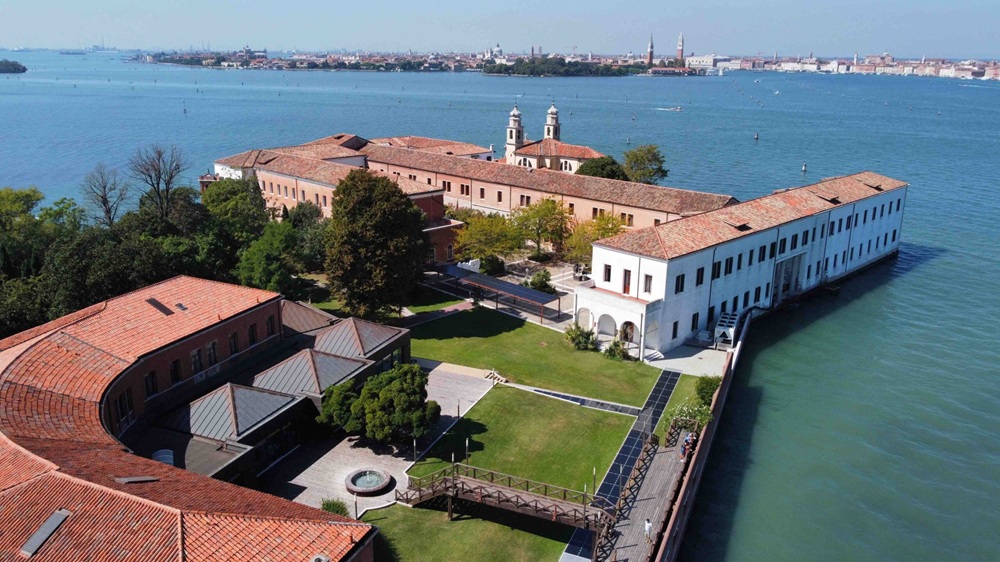
The window opens onto the water, as if on a raft. The bell tower of St. Mark’s can be seen nearby and it looks as you could touch it just by stretching out your hand. These very same thoughts must have gone through the minds of so many people who came to visit the Island of San Servolo over the centuries and ended up staying. First it was a convent for nuns from the kingdom of Candia in Crete from 1600 onwards, then a hospital managed by the Brothers Hospitaller of Saint John of God, and finally an asylum until it was closed down in 1978.
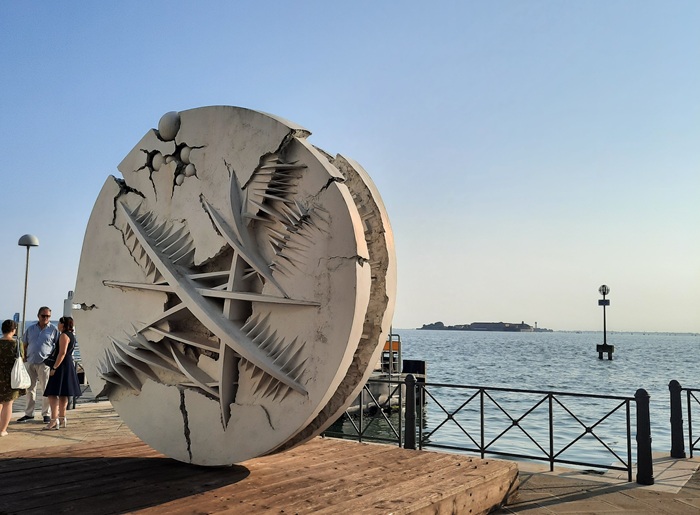
Arnaldo Pomodoro, Disco in forma di rosa del
deserto n. 1, 1993-1994, fiberglass, 620 × ø 320 × 100 cm
This is the historical background that gives San Servolo a special aura. You feel as if you are entering a metaphysical and decidedly composite world: a large natural park, old psychiatric hospital buildings and an ecclesiastical complex now mainly used for hospitality purposes. The restoration of the eighteenth-century church has preserved much of the original structure that was redesigned in the 1800s to incorporate a loggia on the façade. It also has a pediment on the top flanked by two towers. Contemporary "site-specific" artworks greet visitors right from the entrance: Arnaldo Pomodoro's "Desert Rose-Shaped Disc" stands outside the reception alongside a bronze work by the Chinese artist Han Meilin ("Two Pandas") that seem to be very focused on themselves. These rather self-deprecating feel runs right through the complex, including "Robe da Matti" restaurant, which is located just beyond a painted steel sculpture called "Espiga Naranja" by the Mexican artist Sebastiàn (the alias of the artist Enrique Carbajal González). It is located on the campus of Venice International University founded in 2024 to mark the 150th anniversary of the opening of diplomatic relations between Italy and Mexico.
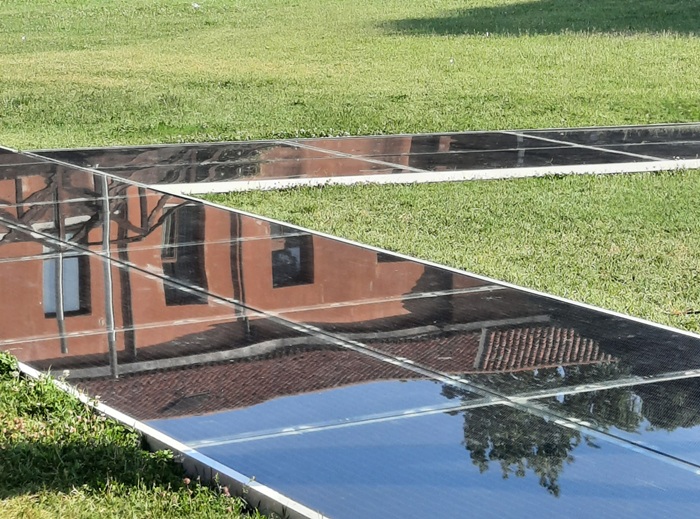
San Servolo, however, is something more than all this: it is where the Venice Light Year project was implemented, an energy enhancement programme for lighting that made the island more efficient and sustainable thanks to the use of high-performance, innovative, green technologies. It is the first example of Project Financing in Italy based on sharing capital among a community of citizens through equity crowdfunding. LED lighting and photovoltaic panels are not an absolute novelty: what is genuinely new is the "stylish" way the panels have been set on the ground. They trace a path across the island, creating the illusory effect of navigating around the Venetian canals.
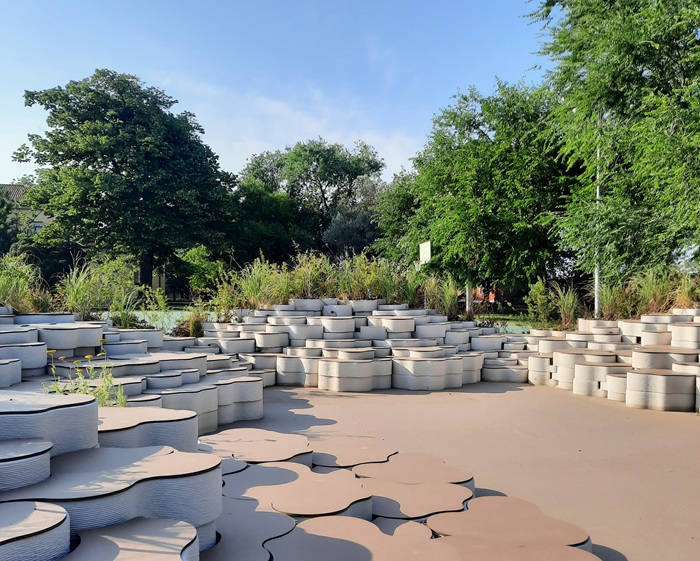
Mario Cucinella Architects, A flower in San Servolo
Once again, there is a subtle irony in the way visitors appear to be walking across the waters over to the amphitheatre designed by the architect Mario Cucinella that opened in May 2025. The 'Flower of S. Servolo,' 800 3D-printed modules that look like a flower arrangement, emerge at the bow of this bizarre raft-island out in the lagoon of one of the most famous cities in the world. As Peggy Guggenheim once said, the only thig that could rival the city’s beauty was its own reflection in the water. Alba Basile